
.svg)


November 24, 2025
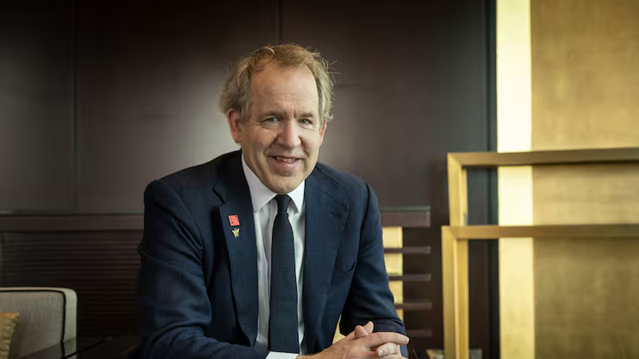
Artificial intelligence is “without doubt” transforming aspects of the global labour force, a UK university leader has said.
Prof Duncan Ivison, president, vice chancellor and professor of political philosophy of The University of Manchester, said that while AI would create new roles, more and more tasks once done by graduate employees in fields such as consultancy, legal and analysis were being done by AI models.
Speaking to The National in Dubai on Monday, Prof Ivison said economic factors such as taxes and delayed investment along with rising automation were also driving this but many companies were building their own AI models to this end.
“I don't think we can say AI is responsible for everything that's happening,” said Prof Ivison, but he added that AI “without doubt is transforming aspects of the labour force”.
“We're entering a period where lots of jobs will be eliminated or changed by the deployment of AI but new jobs and new tasks will emerge. How do we make sure people are prepared for those changes?"
Prof Ivison, who is essentially the main academic and administrative officer of the university, was speaking during his first visit to the UAE in the role.
The university, which has about 44,000 students, was founded in 1824 during the Industrial Revolution. It is the alma mater of 26 Nobel Prize winners, the university says. It is ranked the sixth-best university in the UK and 46th in the academic ranking of World Universities for 2025.
Prof Ivison's visit also comes as the university launched a £400 million global fundraising and volunteering campaign to drive change in education and find solutions to the world's most pressing problems.
"[The university] was founded by philanthropists who wanted Manchester to have a new university to deal with the challenges the Industrial Revolution was generating," he said. "So it's really harking back to that history but thinking about the future."
The university also has centres in Dubai, Hong Kong, Shanghai and Singapore. The Dubai branch opened in 2006 at Dubai Knowledge Park. It offers MBAs and courses in educational leadership and finance. More than 2,600 students have graduated from it. The University of Manchester-Dubai class of 2025 comprises 135 students, and students come from around the world.
“Most of our MBA graduates will stay in the region,” he said. “And a lot stay in Dubai and Abu Dhabi and really build their lives and careers here.”
It is the rise of AI, however, that is dominating debates around education across the globe. According to the International Monetary Fund, AI will affect almost 40 per cent of jobs, replacing some and complementing others.
Prof Duncan Ivison
- We don't want to leave people behind
Prof Ivison outlined just how it was shaking up the education sector. Firstly he said students were “really hungry for AI skills” and wanted to know “how to use AI responsibly” in a changing world.
“Responsible AI is deploying AI in accordance with the values that we want our societies to be organised around and, in liberal democracies, that means we don't want to leave people behind." Secondly, he said that AI was transforming research in a “remarkable way”.
“Some of the generative AI models and tools that are being developed are going to be the equivalent of having a postdoc or having a couple of PhD students. That doesn't mean that we don't still need postdocs and PhD students but it will accelerate the ability of researchers to do things that otherwise would have taken much longer,” he said.
He said a third element was that risk that AI could intensify inequality between people and countries. “AI requires investment, it requires skills and it requires a whole bunch of things that are unevenly distributed in our society so we are thinking a lot about how do we make sure that universities are not contributing to the worsening of those inequalities,” he said.
Turning to the broader education landscape, he said migration was transforming higher education in all sorts of ways. He pointed to the decline in international students going to the US and international student caps elsewhere, but said there was still “strong demand” for students to come to Manchester.
He said the university wanted to expand the remit of its global centres, such as the one in Dubai. “Dubai has an extraordinary concentration of higher education institutions, especially from the UK, so it's always been a higher education centre of excellence and I don't see any reason why that won't continue,” he said.
“What's fascinating is that we're seeing more and more people use the MBA as a springboard into another opportunity, maybe a start-up or maybe a different role entirely.”
The university has also just launched its “Manchester 2035” strategy, which underlines the importance of its branches such as Dubai as a gateway to help address some of the world’s “grand challenges”. Aside from technology, Prof Ivison said these challenges include climate, migration and an “entrenched inequality” across the world.
“Look at how the world deals with immigration now. It's causing political and economic tensions in Europe and in North America. Climate will drive migration. Inequality will drive migration.
"What makes these distinctive at this time is the intersection between them, such as the way that migration and inequality are connected, the way that inequality and technology are connected, and the way that climate is connected to basically all of them in different ways,” he said. He added that the university’s role is to use its expertise to help solve these challenges.
“How do we bring our material scientists together with our economists or our philosophers together with our health researchers or our health researchers together with our computer scientists? As a university, we are looking at the full range of our disciplines to help address these challenges.”



.avif)