
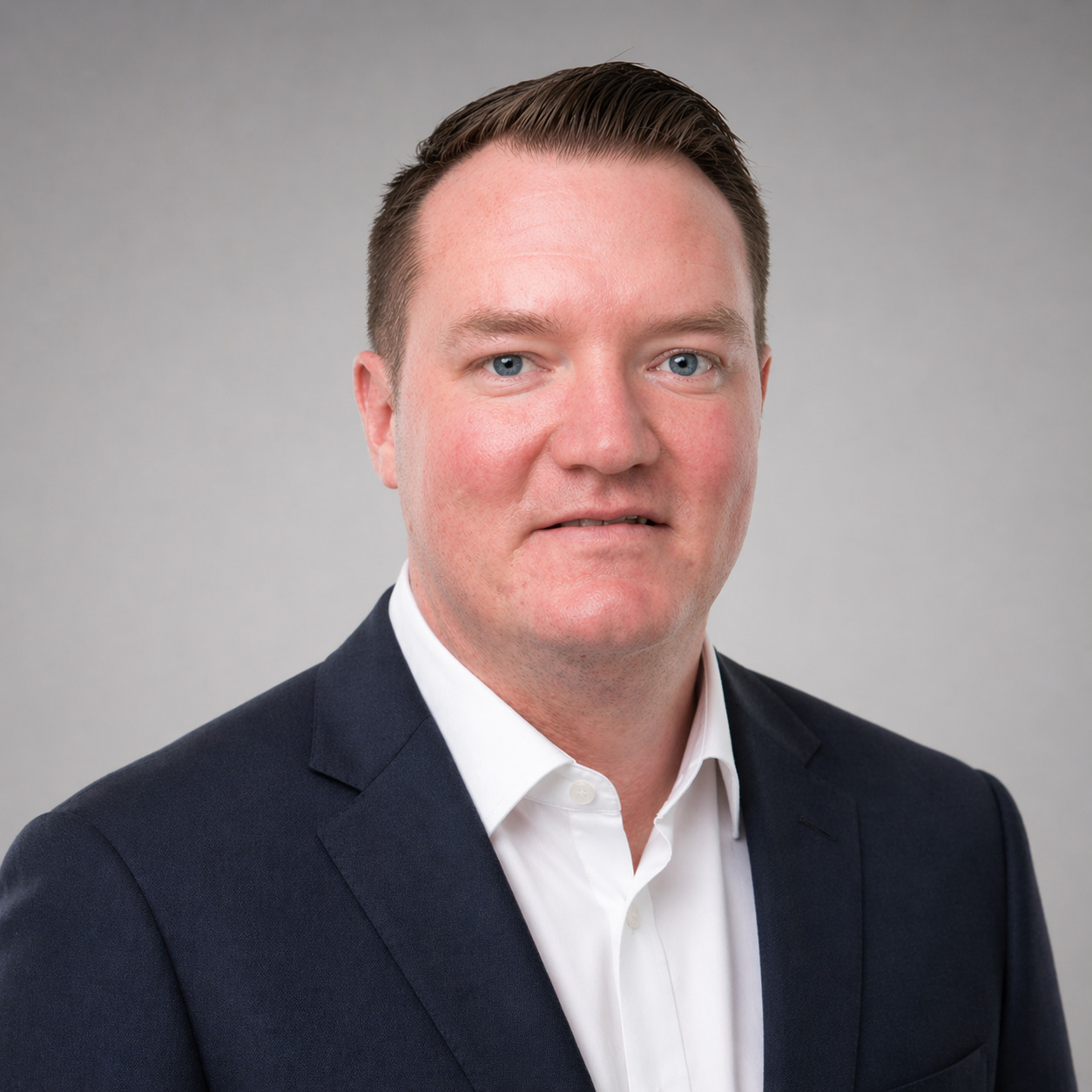
For Mitchell van Wyk, an MBA was never simply about adding another qualification to an already established finance career. It was about broadening his perspective — moving beyond the numbers to understand the elements that come together to drive organisational performance.
Today, Mitchell is Finance Director and an operational leader within the UAE. His international career has taken him across the UK, Australia, Africa and the UAE, with experience spanning catering, facilities management, energy and resources, defence and healthcare.
In his current role, Mitchell oversees finance, legal, IT, business optimisation and several operational business units within a large UAE joint venture employing approximately 4,000 people across more than 100 locations.
His career has included business turnaround, margin improvement, working capital and treasury, commercial finance, M&A due diligence, ERP transformation, corporate governance, operational performance and business strategy. Alongside his professional experience, he is an FCMA, CGMA and Global (Executive) MBA graduate of Alliance Manchester Business School.
Mitchell first connected with The University of Manchester while working in the Manchester area earlier in his career. When he later decided to pursue an MBA, that existing connection, combined with the University’s international reputation and the flexibility of the Global MBA, made Manchester a natural choice.
The international character of the programme was particularly important to him.
“My career has taken me from the UK to Australia, across Africa, and then to the UAE, working in international organisations and across culturally diverse teams.”
He wanted an MBA experience that reflected that environment — one that would bring together perspectives from different countries, industries and professional backgrounds.
For Mitchell, this diversity became an important part of the learning experience. Rather than learning from text books and theory, he was able to engage with people whose professional experiences and approaches were often very different from his own.
When Mitchell joined the MBA, he was already an experienced finance professional. His motivation was therefore less about developing further technical expertise in finance and more about expanding his understanding of the wider organisation.
“I wanted to broaden my understanding of strategy, leadership, operations and how the different parts of an organisation come together,” he explains. “ My ambition was to develop from a finance specialist into a more rounded business leader.”
The timing of the MBA also coincided with an important period in his career. As he moved into a Finance Director role with increasing responsibility, he found himself needing to operate at a more strategic level.
Balancing an executive role with the demands of the MBA was challenging, but it also created an opportunity to put learning into practice immediately.
“I could immediately apply much of what I was learning to real situations at work,” Mitchell says.
That practical connection between study and work has remained one of the most valuable aspects of his MBA experience. Since completing the programme, his responsibilities have expanded well beyond traditional finance to include operations, legal, IT and business transformation.
One of the most significant impacts of the MBA has been the way it has changed Mitchell’s approach to decision-making.
“The Manchester experience gave me a stronger strategic framework for approaching complex decisions,” he says. “It helped me look beyond the numbers and consider how finance connects with people, operations and long-term strategy.”
For a finance leader working within complex service businesses, that broader perspective is particularly relevant. Mitchell has developed a strong interest in understanding the underlying economics of organisations and translating financial insight into practical commercial and operational action.
The MBA has also strengthened his confidence in challenging established thinking, working across functions and contributing at executive and board level.
For Mitchell, this is the real distinction between acquiring knowledge and developing as a leader: understanding not just what the numbers say, but what they mean for the people, operations and strategic choices behind them.
Graduation was not the end of Mitchell’s relationship with the University. As an Alumni Ambassador, he continues to contribute to the Manchester community through panel discussions, conversations with prospective students and University events.
For him, the alumni relationship works both ways.
“The value of the University relationship should not end at graduation,” he says. “Manchester has a genuinely international community, and remaining involved provides opportunities to continue learning, build relationships and hear from people with very different experiences.”
Mitchell sees his role as an opportunity to share an honest perspective on both the MBA and his own career journey. By discussing his experiences with prospective students and fellow alumni, he hopes to offer practical insight into what the programme can provide and what may be possible afterwards.
He was particularly appreciative of being recognised for his contribution to the alumni community, but says the most rewarding aspect is knowing that his experience might help someone else considering a similar path.
Looking back, Mitchell sees the Global MBA as an important part of his transition from a technically focused finance professional to a broader business leader.
For Mitchell, the impact of the MBA lies in the change in perspective it created.
“The qualification itself is valuable, but the long term benefit has been the way it changed how I think, lead and connect numbers, people and strategy.”
That philosophy continues to shape Mitchell’s approach to leadership today — combining financial insight with commercial judgement, operational understanding and an appreciation of the people behind the business.
For current students, his journey offers a reminder that an MBA can be about more than developing expertise in a particular discipline. It can also provide the perspective, confidence and international network to connect different parts of a business and take on broader leadership responsibilities.
And for the Manchester alumni community, Mitchell’s continued involvement demonstrates that the relationship with the University can continue to evolve long after graduation — through shared experiences, professional connections and a willingness to help the next generation of Manchester graduates move forward.